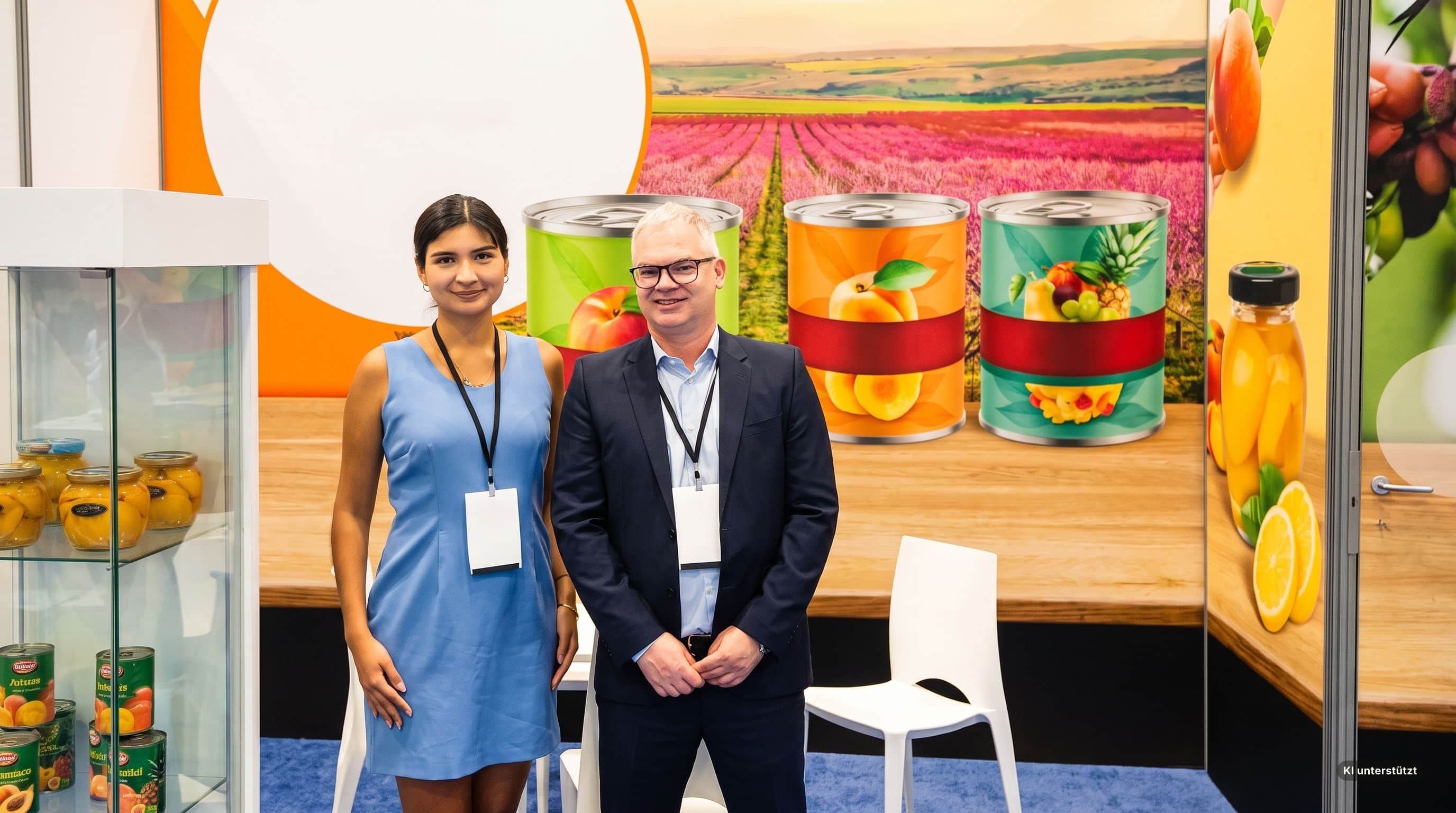
New York in June, the Jacob K. Javits Convention Center, aisle 19: among booths from more than 50 countries, three cans stood on a light wooden table representing entire harvest years in northern Greece. Peaches, apricots, fruit cocktail, all under the FALANI brand. Behind them a wall graphic of orchards in blossom, running in rows to the horizon. That very image, field and finished product side by side, is the shortest explanation of what ELBAK has been doing since 1972.
Why the 70th edition of the show was the right place for Greek fruit
According to the Specialty Food Association, the Summer Fancy Food Show 2026 ran from 28 to 30 June 2026 in New York City and was the 70th edition of the event. The SFA reported more than 32,000 participating manufacturers, buyers, distributors, media representatives and industry professionals. Reports indicate more than 2,400 exhibitors from over 50 countries. Anyone planning ranges in the North American specialty food segment can hardly avoid these three days.
For a producer of canned fruit, a show like this is more than a contact exchange. Canned goods live on confidence in consistency: same calibre, same syrup grade, same colour, container after container, season after season. That commitment can be claimed in an email and demonstrated at the booth. You open a can, look at the halves, check firmness and break, smell, taste. After that, the conversation about price and volume is a different one.
Then there is the timing. At the end of June processing starts up in northern Greece, while in the US the talk is already about programmes for the coming year. The window fits: anyone registering demand at the Javits Center is talking about a harvest just entering the plant, not about an abstract future.
Booth 1929: two faces, one commitment
In the photo from the booth, two people stand in front of the brand wall, Alicia Fernandes and Ioannis Koutsoboulas, both wearing the show's exhibitor badge. No elaborate stage set, no show kitchen. Instead a logo with the words "Food Processing Company, est. 1972", the line "Natural side of", a display case with jars of golden peach halves, on the shelf below cans of peaches and fruit cocktail, beside them a bottle of peaches in syrup and the signature "Hand Harvested".
That is a deliberate decision. A buyer considering a private label programme does not need a production, but answers: which calibres are available? Which can sizes run on which line? What does label adaptation look like? Which certifications are in place? How quickly can samples be dispatched? Answering such questions directly across three show days shortens procurement processes that otherwise take weeks.
What was on the table
The three cans in the foreground show the core range: peaches, apricots and fruit cocktail of peach, pear, pineapple, grape and cherry, each in light syrup. The labels carry the sentence that matters: hand harvested, carefully selected, for customers around the world. Beside them the jars, relevant for buyers who need shelf visibility and resealability.
What buyers from over 70 countries actually examine at a booth
For its summer show the SFA highlights networking, business development and product discovery, and explicitly addresses makers, buyers, brokers and distributors. In practice, a serious conversation at the booth usually follows the same points:
- Raw material and origin: where does the fruit come from, how far is the route from tree to processing, how short is the time in between?
- Depth of processing: who controls growing, sorting, filling and distribution? Every interface fewer means one source of error fewer.
- Capacity and predictability: what volumes are committed per season, what happens when harvests fluctuate?
- Private label or own brand: does the product run under FALANI or under the chain's label?
- Documentation: specifications, analytical values, certificates, traceability down to the batch.
ELBAK answers these points from a single source, because the chain from growing through processing to distribution lies in-house. That is not a marketing argument but a scheduling one: those who do not have to coordinate deliver binding answers faster. Retail chains from more than 70 countries have been working with us for years for precisely this reason.
Hand-picked is not a picture for the label but a production decision
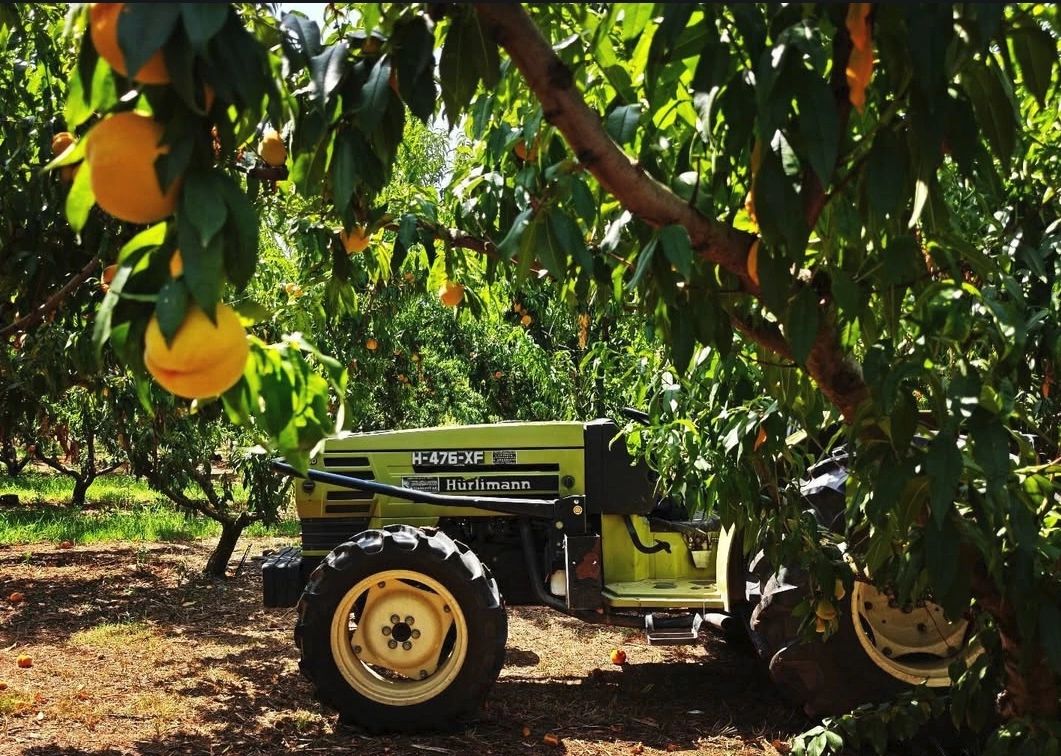
Harvesting peaches and apricots for canning is precision work. The fruit must be ripe enough for aroma and colour, yet firm enough to survive halving, stoning and pasteurisation without falling apart. This window is narrow, often only a few days per variety and site. Mechanical harvesting does not hit it reliably; a trained picker does. That is why we pick by hand, and why "Hand Harvested" appears so prominently on the booth wall in New York.
The second lever lies in the time between field and plant. The shorter this span, the fewer bruises, the more stable the texture and colour in the finished product. The proximity of our production to the growing areas in northern Greece is therefore no accident of location but part of the quality calculation. What a buyer finally sees in the opened can, even halves without fibre break, is created in those hours.
Our position on this is clear: canned fruit is not a compromise against fresh produce but a discipline of its own. Gently preserved fruit is available all year, transportable over any distance and calculable in its quality. That is exactly what retail chains need when filling shelves in many markets at once.
What happens after the show and when the next date comes
Trade shows are rarely decided at the booth. They are decided in the four to eight weeks afterwards, when samples arrive, specifications are reviewed and the first calculation is on the table. Anyone who met us at the Javits Center should pick up the thread now: a sample request with the desired calibre and packaging, the target volume per season, and the question of whether the product should run under FALANI or as a private label. Everything else follows from there.
For everyone who did not make it to New York in 2026: the Specialty Food Association names 25 to 27 July 2027 in New York as the next Summer Fancy Food Show. Until then we hold conversations where they are needed, by video call, by phone or directly at our production site in Greece. A visit during the season is the most convincing option anyway: between intake, sorting and filling, two hours explain more than two show days.
In the end, the photo from booth 1929 shows nothing spectacular, and that is precisely the point. Two contacts, three cans, an orchard in the background. Between them lie more than fifty years of work on a product that has to be equally good every year. Whoever delivers that needs no loud appearance.