In brief
The first crates are at intake, the lines are starting up, and for the weeks ahead only one rhythm counts in Larissa: that of the fruit. Elbak S.A. announced the start of peach canning on LinkedIn, emphasising that the arrival of the first fresh peaches marks one of the most exciting and most demanding phases of the year. Anyone who has stood in a Greek fruit-growing region in July knows why: ripeness does not wait. What is perfect on the tree today is overripe two days later.
The tractor in the shade of the trees shows where quality is decided
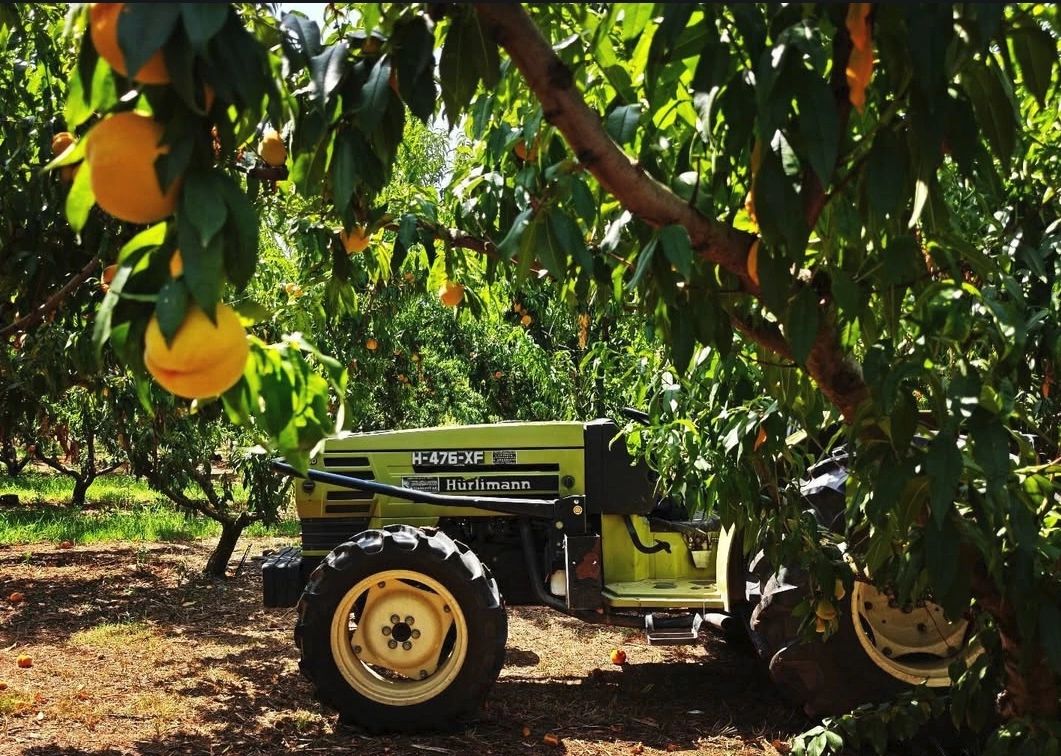
The picture that opens this season shows no factory gate and no filling line, but an orchard in full light. A small tractor stands between the rows, half hidden by low-hanging branches. The fruit reaches into the foreground, firm, washed in orange-yellow, some with droplets of water on the skin. Windfall lies in the dried grass below, and behind it the row opens into a green half-light.
This image is not a romantic motif but a statement about the order of things. Quality in the can is not created in the factory; it is decided in the orchard. The moment of harvest, the degree of ripeness, the handling of the fruit in the first minutes after picking: all of this determines how much room production will have later on. A peach picked too early will not become aromatic in any process in the world; one picked too late falls apart when halved.
That is precisely why the tractor stands where it belongs: right at the trees, short distances, quick departure. In the peach business, the distance between tree and plant is no logistical footnote — it is the actual quality factor.
From early July to the end of September, every day counts
Elbak gives early July to the end of September as the period for the peach harvest. That sounds like three months, but it is in truth a chain of short windows. Every variety, every site, every altitude ripens at its own moment. The task is to line up these windows so that the plant runs continuously and yet no lot misses its optimum ripeness.
Hand-picking here is not nostalgia
According to Elbak, the fruit is harvested by hand. With peaches this is not a question of tradition but of physics. The skin is sensitive to pressure, the flesh yields immediately under mechanical load, and every bruise is visible later in the halved fruit. An experienced picker can tell from the ground colour whether the fruit is ready. That judgement is hard to automate.
Pasteurisation without a holding pattern
After harvesting, the company states, the peaches are pasteurised without delay and processed immediately after picking, with no preservatives added. This point is decisive for buyers because it answers two questions at once. First, aroma: what reaches the can quickly loses less. Second, labelling: a product without preservatives saves discussions on the shelf and in the declaration.
Thessaly and Macedonia provide the basis
According to Elbak, the peaches come from orchards in Thessaly and Macedonia in northern Greece. The company is based in Larissa in Thessaly; several trade directories list the address on Larissas-Falanis Road. This proximity between growing area and plant is no accident of company history — it is the business model.
For stone fruit, northern Greece is one of Europe's serious addresses. Hot, dry summers, cool nights, calcareous soils on the Thessalian plain: this combination produces fruit with high sugar development and stable structure — exactly what a canned product needs. A peach that disintegrates in syrup may have been delicious fresh, but in the jar it is useless.
For buyers, regional concentration also means predictability. Sourcing from several neighbouring areas allows a response to local weather events without rebuilding the entire supply chain. Hail in one location is annoying, but it does not topple the season.
Whoever controls the whole route can commit to quality
In its own account, Elbak describes monitoring the entire production process from harvest to the ready-to-ship product. That is the sentence on which everything in this business turns. A producer buying raw material on the spot market can hope for quality. A producer holding growing, harvesting, processing and distribution in one hand can commit to it.
In practice this means: the choice of variety in the orchard follows what the line is later meant to process. The harvest day is planned according to the plant's capacity and the degree of ripeness, not according to the calendar. And when a lot falls outside the norm, it is known which site it came from.
What buyers should take from this
For retail chains, importers and distributors, what counts in the end is less the single outstanding lot than the spread across the season. A calibration in August that matches July. A syrup grade that does not drift. A halved-fruit shape that stays recognisable on the shelf. That is exactly what an integrated chain aims at. Elbak describes itself as one of the leading producers of canned fruit in Greece and cites distribution in more than 70 countries. That figure describes ambition rather than reach: anyone supplying that many markets has to meet the same specification in every one of them.
A company working to the rhythm of the fruit since 1971
According to company and industry profiles, Elbak S.A. was founded in 1971. That is more than five decades of peach seasons, each with its own weather, its own ripening curves, its own surprises. In the canning business this experience is not a marketing argument but an operational advantage. Anyone who knows how a cool June affects the ripening sequence in July plans shifts differently.
The LinkedIn post on the season's start names three groups coming together in these weeks: growers, production teams and quality experts. That is precisely observed. In peak season the balance of power shifts in every cannery. It is not the sales plan that sets the pace, but the fruit. Those who accept this produce good goods. Those who work against it produce rejects.
What the start of the season means for your planning
The beginning of peach canning is the moment when next year's availability takes shape for the trade. The goods now being produced in Larissa will be on shelves from Athens to Sydney in the coming months. Anyone wanting to secure volumes for 2026 is well advised to hold those conversations not in winter but now, while the harvest is running and the crop situation can be assessed.
Our assessment is clear: with canned peaches, success on the shelf is decided not by the price per can but by repeatability. A consumer who finds a different consistency on the second purchase does not come back a third time. It is therefore worth looking less at the quotation list when selecting suppliers and more at how much of the route a producer holds in their own hands. In an integrated chain, plantation and pallet are a few kilometres and a few hours apart. That is the difference you taste in the can.
We wish all growers, teams and partners a safe and productive season. And the peaches on the trees of Thessaly and Macedonia a few more warm days.